If you've been on TikTok over the past year, you've probably come across Labubu. The mischievous, bug-eyed character was first imagined by Hong Kong artist Kasing Lung in 2015, emerging from sketchbook illustrations inspired by Nordic folklore. For years, Labubu circulated primarily within designer toy and art collectible communities, attracting a dedicated but relatively niche following.
![[Image: @kasinglung Instagram, November 2015]](https://framerusercontent.com/images/LXzAMKl7aVJK26b17bW0ipuqLQ4.png)
Image: @kasinglung Instagram, November 2015
Yet by late 2024, TikTok was suddenly saturated with Labubu-related content. If the character existed for almost a decade before becoming a globally recognisable cultural phenomenon, what changed?
The Two (Creator) Cultures?
In the online Labubu craze, we saw the emergence of two streams of Labubu content online. One centres on the collectible itself. Creators film unboxings, document long queues outside Pop Mart stores, compare rare editions, attach Labubus to luxury handbags, and share stories about their attempts to secure increasingly hard-to-find releases. In many cases, the appeal lies not simply in obtaining the toy itself, but participation in the conversations, communities, and socio-cultural status practices that had formed around it.
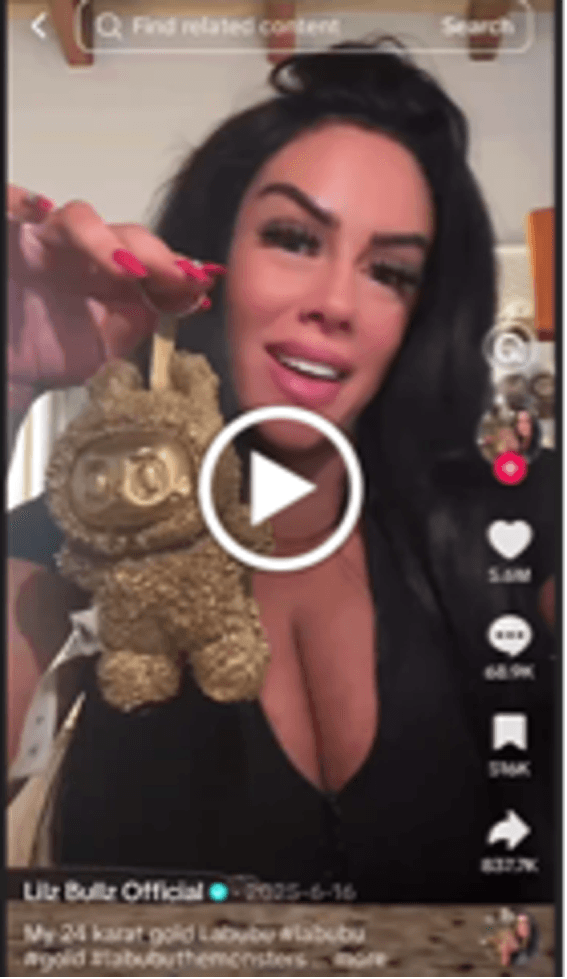
“I have the one and only 24k gold Labubu” – Liz Bullz
Alongside the presenter-focused video, another form of Labubu content was also flourishing. AI-generated Labubu animations were saturating the platform, placing the character in increasingly absurd situations: starring in short dramas, becoming a Formula 1 driver, or cosplaying popular anime characters.
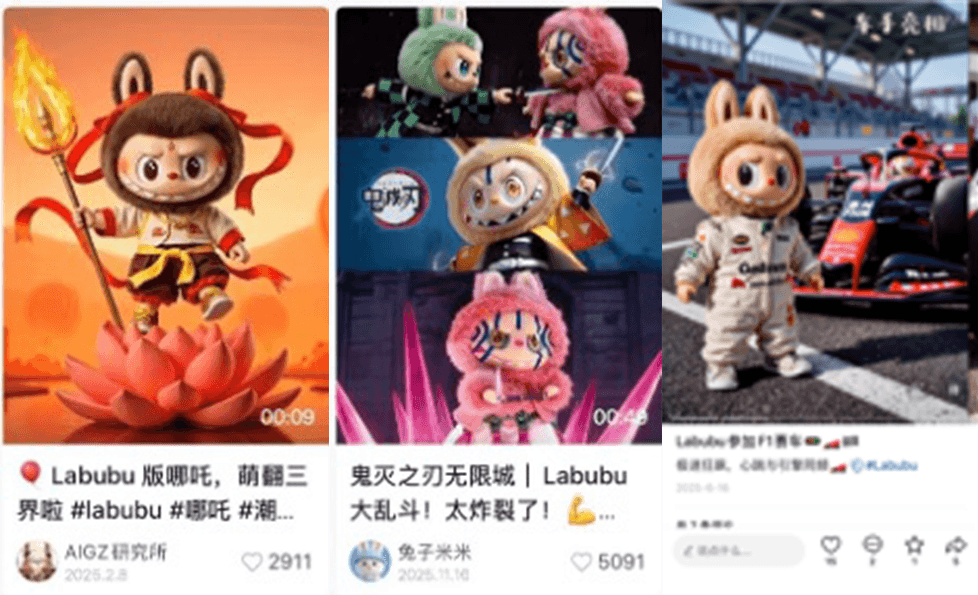
As researchers interested in TikTok, creator cultures, and audiences, we became curious about what Labubu's circulation might reveal about the coexistence of these two creator cultures, and how they are reshaping cultural production on the platform, particularly notions of labour, legitimacy, visibility, and value.
At first glance, they appear fundamentally different:
Presenter-focused creators build content and communities around themselves. Their visibility is anchored in a recognisable creator identity, where content serves primarily to reinforce their public persona and sustain audience relationships.
AI-driven creators operate differently. Their content is typically generated rapidly and in high volume to ‘farm’ engagement, with success depending less on who produced it and more on how effectively content captures attention within platform recommendation systems. This production logic is immediately recognisable as part of the emerging "AI slop" economy, where rapidly generated, highly repetitive media is designed to maximise circulation through algorithmic and affective engagement.
Yet both forms of content contribute to Labubu's visibility. Rather than occupying separate spaces, they both operate within the same attention economy, competing for attention within the same recommendation systems and platform environments.
However, they establish value and legitimacy in different ways.
For presenter-focused creators, Labubu often becomes a vehicle for storytelling, audience participation, and community engagement. One presenter-focused creator we interviewed recalled a video unexpectedly going viral, lining up to buy a Labubu:
"I was lining up for a Labubu... made a brief video asking what the f*** is this? Why do I want one? Normally a good video will get 30k views and this one is at 400k."
The creator quickly realised that audiences were not simply interested in the toy itself, but in participating in the cultural phenomenon surrounding it. Rather than moving on to the next trend, they continued engaging with viewers:
"People were saying things like, 'Here's a secret venue,' or 'I work nearby, come over and I'll give you one.' A lot of the time their ideas are far better than mine."
In this case, value emerges not simply from the visibility generated, but from the creator's ability to foster participation, cultivate relationships, and transform audience interaction into ongoing content and cultural production practice.
AI-driven creators engage with Labubu differently. Rather than serving as a focal point for community formation or identity work, here Labubu functions as a highly visible cultural reference that can be combined with other trending formats, characters, and narratives to maximise circulation. As one AI-driven creator explained:
"The content is really just a shell. Today this is trending, but tomorrow it could be something else…We're not influencers. We don't care about all that flashy stuff. The key is capturing traffic, monetising it, and actually making money."
Here, Labubu is less important as a character or cultural symbol than as a highly visible trend capable of generating clicks, recommendations, and monetisable attention. Today it is Labubu, tomorrow it could be weird fruit babies, shrimp jesus, or whatever captures viral attention. For these AI-driven creators, visibility is pursued less through cultivating identity or long-term audience relationships, but often derived through scale, iteration, and the strategic recombination of recognisable cultural references.
Where to from here?
What Labubu ultimately reveals is not two completely separate worlds, but two distinct creator logics operating within the same platform ecology. The same cultural object can become an accessory to creator identity and community in one context, while serving as fodder for scalable visibility in another.
More broadly, cultural objects do not simply become valuable because they exist. Their value emerges through the creator cultures that mobilise them. Whether characters, memes, trends, sounds, or other cultural artefacts, these objects provide a productive lens for understanding how creators engage with, remix, reinterpret, and derive value from shared cultural materials.
Labubu's trajectory is more than the story of a viral toy. It shows how the same cultural object can sustain very different forms of creator labour, legitimacy, and visibility. Rather than asking only why Labubu became popular, researchers can consider how cultural objects are transformed as they move between creator communities and what those transformations reveal about the changing logics of creativity, identity, and value in contemporary platform economies.
